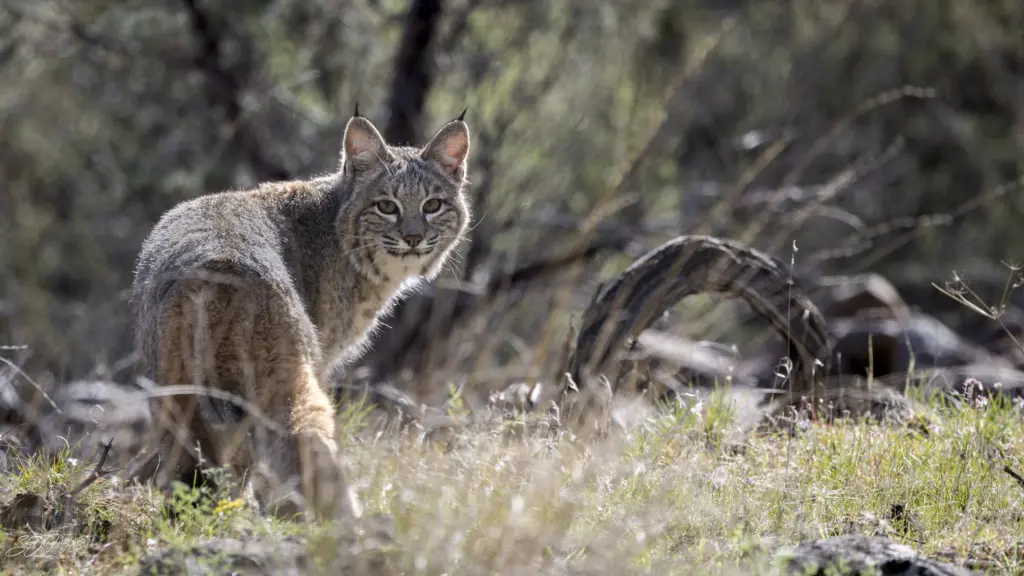
Two juvenile bobcats have been successfully released back into the wild following 10 months of care at Think Wild’s Wildlife Hospital. A team of Think Wild staff and volunteers released the siblings Friday, 3/20, at a remote site near Dayville, selected in coordination with the Oregon Department of Fish and Wildlife. The release marks the end of a long rehabilitation process, in which staff, interns, and volunteers provided critical care, enrichment opportunities, and practice with live prey to raise and prepare the two bobcats for life in the wild.
The bobcat siblings (one male and one female) were admitted on May 19, 2025 at approximately four weeks old and each weighing less than a pound. The rescuer found them alone on the side of the road in Condon, Oregon at Dyer State Wayside and called ODFW. Their mother was presumed killed by a vehicle, and ODFW transported the bobcats for care at Think Wild. On intake, both kittens presented with dehydration, hypothermia, parasitism, diarrhea, and poor body condition.
“The bobcats arrived at Think Wild requiring immediate stabilization, fluid therapy, thermal support, and antiparasitic treatment,” said Dr. Laura Acevedo, Think Wild’s veterinarian. “From the outset, their rehabilitation was structured not only to support recovery, but to prevent habituation and preserve species-appropriate behavior.”
For the next several months, the bobcats progressed from formula feeding to a whole-prey diet of mice, rats, and chicks, with careful monitoring of weight, body condition, and nutritional intake. As they matured, their care shifted toward behavioral development critical for survival in the wild. To prevent habituation, staff minimized human exposure by using full-body camouflage and face masks, ensuring the animals retained a natural avoidance of people.
The bobcats’ enclosure was intentionally designed to replicate natural conditions, with native vegetation, logs, and varied terrain that allowed for climbing, digging, hiding, and resting. Their enrichment opportunities and enclosure features encouraged natural movement and physical conditioning. Play behavior was a key part of their development, as stalking, pouncing, and chasing helped build the coordination and hunting skills they would rely on after release.
As part of their final preparation for return to the wild, the bobcats underwent a structured live prey testing protocol to confirm their ability to hunt independently. Testing progressed from mice to rats, quail, and rabbits, with both animals demonstrating strong predatory responses and consistent success. The patients showed immediate engagement with prey and effective kill behavior across multiple live prey trials.
Because the bobcats were rescued at such a young age, Think Wild implemented a soft release strategy to support their transition back to the wild. The animals were transported to their release site and placed in a large outdoor enclosure for a 24-hour acclimation period, where they could observe their surroundings while receiving food and water. On the second day, the enclosure door was opened, allowing them to leave at their own pace while supplemental food remained available.
The siblings exited the kennel cautiously before moving confidently into the surrounding habitat and out of view.
Dr. Sue Dougherty, Think Wild Board Director, who photographed the release, described the moment:
“As they trotted up the hillside, I stood watching through my camera lens… The air was cool and breezy and felt…Free. I can only imagine how exhilarating it must be for two young bobcats to have their first leap into their natural world!”
Bobcats (Lynx rufus) are native predators that play an important role in maintaining ecological balance. Although common across Oregon, they are rarely seen due to their elusive nature. They face ongoing threats from human activity, including vehicle collisions and exposure to rodenticides.
“Predators like bobcats are essential to healthy ecosystems,” said Sally Compton, Executive Director of Think Wild. “Returning these animals to the landscape where they belong supports natural balance, and it’s especially meaningful when the reason for their rescue was due to human conflict in the first place. Our team of hospital staff, interns, and volunteers did a great job raising these orphans, preventing human habituation and ensuring they will thrive in the wild. We’ll miss the bobcats, but with the cost of prey going up…we’re thrilled to see them go.”
Support Think Wild and their rehabilitation efforts by making a donation, volunteering your time, or joining the 6th Annual Wildlife Baby Shower event – a fundraiser and donation drive to support the wildlife hospital during the busy baby season. If you find injured or orphaned wildlife, please contact Think Wild via the wildlife hotline (541-241-8680), monitored 7 days a week from 8-4.
###
Photo Credit: Sue Dougherty
About Think Wild
Think Wild is a 501(c)3 non-profit organization located in Bend, Oregon. Our mission is to inspire the High Desert community to care for and protect native wildlife through education, conservation, rescue, and rehabilitation. We provide veterinary treatment and care at the wildlife hospital, staffed by expert wildlife rehabilitation staff, animal husbandry volunteers, and our staff veterinarian. We also provide wildlife habitat installations, native plantings, and wildlife education programming for youth and the community, and can help with conflicts with wildlife. Wildlife injuries can be reported to our Wildlife Hotline at 541-241-8680, which is monitored seven days a week from 8 AM to 4 PM. Visit us online at thinkwildco.org, or on Instagram or Facebook @thinkwildco.