Think Wild and Cascadia Wild are partnering to expand rare carnivore monitoring efforts in Central Oregon through volunteer-powered community science, building on Cascadia Wild’s long-running Wolverine Tracking Project, which began in 2001.
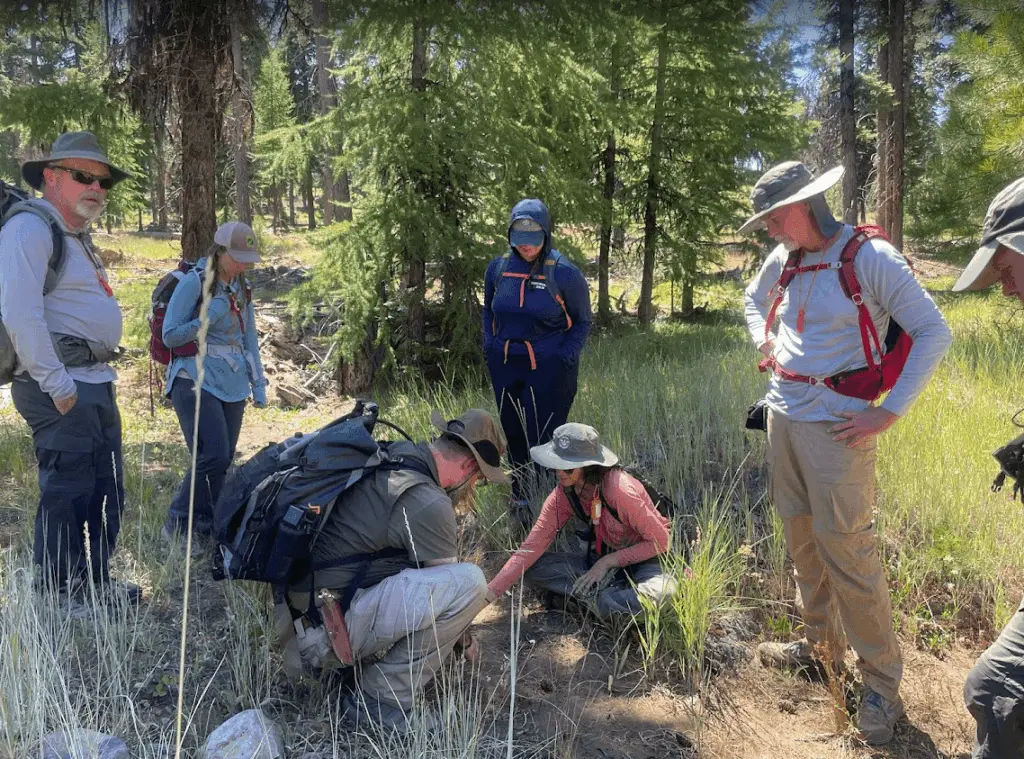
Target species include wolverines, Sierra Nevada red foxes, gray wolves, martens, and other Species of Greatest Conservation Need. Trained volunteers will conduct track and sign surveys and deploy remote cameras throughout the Deschutes and Ochoco National Forests to collect field data. That data is analyzed and incorporated into long-term regional datasets, improving understanding of species distribution, habitat use, landscape connectivity, and broader wildlife community dynamics.
These efforts strengthen state and federal agency capacity, inform responsible wildlife management decisions, and support proactive conflict prevention by providing land managers and communities with clearer information about where sensitive species are present.
Kylie Lanuza, Think Wild’s Wildlife Community Science Project Coordinator, previously volunteered with Cascadia Wild, where she trained and led volunteers conducting rare carnivore surveys through the Wolverine Tracking Project in the Mt. Hood National Forest. After several seasons in the field and discussions with project partners, including the Oregon Department of Fish and Wildlife (ODFW) and the U.S. Forest Service (USFS), she identified both a need and an opportunity to expand similar survey efforts into Central Oregon. She made that expansion a focus of her graduate internship with Think Wild last summer.
“Central Oregon is an incredible place to do this work, with such diverse habitats and a strong, outdoors-oriented community that cares deeply about wildlife,” said Lanuza. “Last year, we piloted wolf monitoring and saw an overwhelming response from people interested in learning, supporting, and volunteering.
That enthusiasm encouraged us to formalize our partnership with Cascadia Wild to expand monitoring efforts in Central Oregon,” continued Lanuza. “What began as a pilot effort has evolved into planned, year-round rare carnivore monitoring, including a winter tracking survey in partnership with Wanderlust Tours, and training planned this spring to prepare volunteers for summer fieldwork with Sierra Nevada red fox and wolves.”
“Participatory science is a great way to create a sense of stewardship and belonging to the land,” said Teri Lysak, Cascadia Wild’s Executive Director. “We are excited to partner with Think Wild and provide opportunities for Central Oregon community members to connect with their wild spaces through our carnivore monitoring and tracking programs. The data the Wolverine Tracking Project gathers informs both research and resource management decisions, and volunteering is a fun, hands-on way to be involved in land stewardship.”
In addition to supporting Cascadia Wild’s carnivore tracking efforts, Think Wild will coordinate community scientists to collect Sierra Nevada red fox scat in alignment with ODFW protocols. This multi-year initiative engages trained volunteers across Central Oregon to gather scat samples for genetic analysis, helping improve understanding of this rare and elusive species.
“These secretive carnivores are notoriously elusive and difficult to document, and there’s a lot of suitable montane fox habitat in Central Oregon that we’d like to survey.” said Kalysta Adkins, Fish and Wildlife Biologist for ODFW. “Fecal samples, or scats, contain genetic information that is left behind by the animal. These samples can be used to answer questions about where an animal is present, what an animal is eating, how healthy it is, or how it competes for resources with other co-occurring mesocarnivores like coyotes. Scientists can answer these questions without needing to trap, handle, or capture animals.”
This work builds on Think Wild’s growing wildlife monitoring program, which includes beaver activity surveys, osprey nest monitoring through Osprey Watch, and year-round trail camera data collection across the region. Together, these efforts create a more complete picture of ecosystem health and wildlife movement in Central Oregon.
“Utilizing community science allows us to train volunteers to help conduct surveys for wildlife while they are recreating on Central Oregon’s beautiful trail systems. The more help we can get from interested volunteers to help us cover the extensive habitat, the better.” said Adkins.
Sally Compton, Executive Director of Think Wild, serves on the Deschutes County Wolf Compensation and Financial Assistance Committee, contributing to local and statewide conversations about wolf management and coexistence. Field-based monitoring, including carnivore tracking, directly informs responsible wildlife management practices and supports data-driven decision-making. Kylie Lanuza, Think Wild’s Wildlife Community Science Project Coordinator, is leading and coordinating these tracking efforts locally.
While current winter tracking field days are full, there are two upcoming virtual trainings for community members to get involved in Think Wild’s wildlife-monitoring and community-science projects this year:
-
Wolf Tracking Training on Thursday, May 14 6-8pm (RSVP required)
-
Scat Collection Training on Monday, June 8 6-8pm (RSVP required)
We’re also raising funds to support this work across Central Oregon, covering staff time, training and field coordination, equipment, and research. You can learn more and donate on Think Wild’s website.
###
About Think Wild
Think Wild is a 501(c)3 non-profit organization located in Bend, Oregon. Our mission is to inspire the High Desert community to care for and protect native wildlife through education, conservation, rescue, and rehabilitation. Wildlife injuries can be reported to our Wildlife Hotline at 541-241-8680, which is monitored seven days a week from 8 AM to 4 PM. Visit us online at thinkwildco.org, or on Instagram or Facebook @thinkwildco.